Going ahead with surgery after 4 years of suffering
Ahmed, USA - ahmed082521@gmail.com
Posted 2021-10-03
My coccyx pain started about 4 years ago when I was in grad school. I used to sit for a long time (10-12 hours a day) and my ergonomics were not always the best. It took me a while to realize that this is a coccyx pain. But when I did, I learned about this website which provided me with an incredible amount of information about this rare spine condition. Which is a good chance to thank Jon Miles for his incredible efforts here! I learned about the appropriate cushions and how to sit properly to minimize the pain and I kept doing that for about a year, but unfortunately the pain was just getting worse. I also started to develop pain and numbness in my left leg (primarily in the thigh area). So once I finished grad school I started seeking medical help.
The first few doctors I saw had no clue how to diagnose my condition or help me. I went to a pain management doctor which went ahead and recommended a nerve block (Ganglion Impar block) without even doing an X-ray or MRI for my coccyx. I was having severe pain and wanted any kind of relief, so I agreed to this injection. Unfortunately, the injection did not make any difference at all. That was in December 2018. When I saw the doctor for follow-up, he ordered lumbar spine MRI for me because he said it could be a referred pain. The lumbar spine MRI showed 2 disc bulges at L4/L5 and L5/S1. For a while there, I was made to believe that my main problem is the lumbar disc bulge and the coccyx pain is just a referred pain. The disc bulge I had seemed very mild on the MRI but the pain/numbness I had in my left leg made this theory somewhat plausible. I started a physical therapy program focused essentially on treating sciatica symptoms. After about 4 months in physical therapy, I got some relief in my leg pain/numbness but my coccyx pain was pretty much the same.
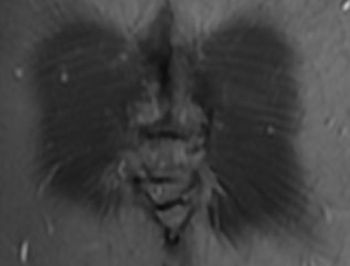
I came back to this website and started looking for a solution, I found a chiropractor named Alan Nunez in Glendale, CA that some people here recommended for treating coccyx pain (see Doctors and specialists in the USA, California). I did about 6 sessions with him again with no relief. This is now June 2019, roughly a year and half since the onset of my symptoms. At this point, I also started feeling pain in my low-back. I'm guessing it's because I have been sitting in awkward positions (leaning forward, leaning on one side, etc.) for a long time to compensate for my coccyx pain. I went to see another pain management doctor. And that's when I was finally ordered to get a coccyx MRI. The MRI report said that the coccyx looks fine! However, when I got the CD and looked at the images myself (see attached images), I could see in one of the views that the coccyx is tilted to the left, which is exactly how I have been feeling! The pain management doctor offered me another ganglion impar block, but I refused since it didn't make any difference the first time.
At this point I decided to go see a spine surgeon at Cedars-Sinai spine center in Los Angeles. Unfortunately, I got assigned to this old surgeon who was too confident and wouldn't even listen to my symptoms! He just looked at the MRI images for the lumbar spine and coccyx and said that my coccyx looks fine, and even if it wasn't there is nothing that could be done about it (I'm sorry what?!). He just kept saying that my L5-S1 disk bulge is pressing on the nerve and needs an injection and that should relieve my pain. I wasn't convinced since he didn't take the time to listen to my story. So I switched to another younger surgeon within the same center. The new surgeon listened to my story and then told me that coccyx surgeries are very rare and the success rate isn't very high, and he strongly advised me against the surgery option. He said that the L5-S1 spine injection might relieve my leg pain and that's the only thing they can help me with. So I went ahead and did the spine injection. Unfortunately, there was no relief out of it; not in my low-back, not in my leg, absolutely nothing! I went back to the doctor, he then ordered a nerve conduction study to get a better understanding of what's going on. The results of the study said that everything looks fine and that the nerve activities in both legs are the same. So, I went back to the spine surgeon and at this point he was very puzzled and he just said "I don't know".
In early 2020 (roughly 2 years after the onset of my symptoms) I moved to the San Francisco Bay Area. I decided to see a new spine surgeon at UCSF. Again, they had no clue about the coccyx but they tried to diagnose my left leg pain/numbness. So they ordered an ultrasound study of my left leg. The results came back normal. Again, I was told "I don't know". So, I tried to switch specialty and see a neurologist at Stanford Health Care. They did another nerve conduction study on the legs and said that everything is normal. However, based on my symptoms, they suggested that I might be having meralgia paresthetica (compression of the lateral femoral cutaneous nerve) which causes the numbness sensation in my thigh. They also said that since this condition only affects sensory nerves, it wouldn't show up on the nerve conduction study. So they put me on "gabapentin" and warned me about the side effects. After only 2 days I decided to stop the medicine. The side effects were intolerable for me.
In late 2020 I moved back to Southern California and started to see a new primary care physician. He recommended that I try acupuncture and osteopathic medicine. I decided to try acupuncture for lateral femoral cutaneous nerve compression. I did about 7 sessions and that was the first time I got significant relief in my left leg symptoms. At that point, I knew that they are unrelated to my L5-S1 disc bulge and that my disc bulge is probably asymptomatic. I also started to develop the theory that the lateral femoral cutaneous nerve compression is due to the awkward sitting positions that I have been doing to compensate for my coccyx pain. So I started to shift my focus back to the original problem: the coccyx.
I went to see the osteopathic doctor, they did a full assessment of my musculoskeletal system and recommended that I try Perineural Injection Therapy (PIT) and Prolotherapy for the coccyx. I started with the PIT since it's easier and covered by the insurance. Prolotherapy is not covered by most insurances since it's still considered experimental. I felt no relief after two sessions of PIT at the coccyx, so the doctor said there's no point in continuing this treatment. And recommend that I try pelvic floor physical therapy. I did about 10 sessions of pelvic floor PT and I did get some relief out of it. But it didn't resolve the problem.
This is now around March 2021, I thought maybe I should give prolotherapy a chance. Oh boy, it was so painful! I did 2 prolotherapy sessions, one month apart. And surprise, my coccyx pain got WORSE! I thought I should do another MRI for the coccyx because it's been almost 2 years since the previous one. So my doctor ordered a new one for me. This time the report mentioned something about the coccyx. It said "focal moderate degenerative changes noted at the sacrococcygeal junction, with adjacent cystic change".
At this point I was so frustrated I went back to this website and started to look for solutions. I found a lot of success stories with Dr. Patrick Foye in New Jersey (see Doctors and specialists in the USA, New Jersey). So I called his office and found that they offer telemedicine appointments. I mailed them my previous imaging studies and scheduled a video appointment with Dr. Foye. And this is when I finally found someone who understands my condition! After reviewing my imaging studies, Dr. Foye noted that my coccyx MRI from August 2019 is indeed showing the left tilt in my coccyx, which is what I've been feeling all along (and noted myself before!), and the MRI report failed to mention anything about it. However, to have a complete diagnosis, we needed to do the sit-stand coccyx x-ray. Since I couldn't find any local places to do this kind of x-ray, I decided to fly to NJ to have the dynamic coccyx x-ray done at Dr. Foye's facility. And possibly get a coccyx steroid shot on the same day as well.
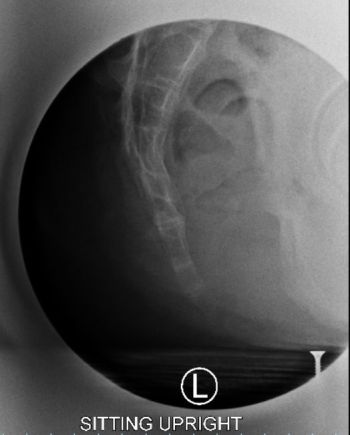
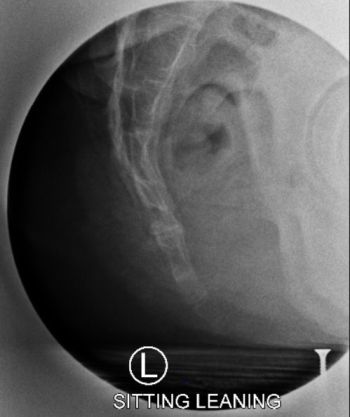
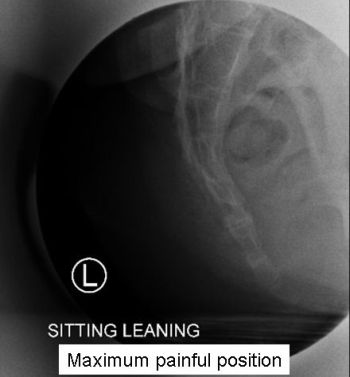
I flew to NJ in early July 2021 to see Dr. Foye. I did the sit-stand coccyx x-ray (see attached images). The results ruled out hypermobility/dynamic instability and showed that the coccyx range of motion upon sitting is very limited (~ 11 degrees), making it somewhat rigid. The results also mentioned some mild arthritis changes and fusion of the sacrococcygeal joint. Also, the first inter-coccygeal joint seems to be fused. That makes all the coccyx range of motion coming from the second inter-coccygeal joint (the joint between the second and third coccyx segments). After Dr. Foye reviewed the x-ray, he mentioned the possibility of a bone spur at the very end of the last coccyx segment. It was not very obvious on the images even after adjusting the contrast, but he kept saying that he could see it! After some discussions with the doctor, I ended up doing a steroid injection along with a ganglion impar block. The doctor made sure to inject the tip of the coccyx because he believed the bone spur is the major cause of my coccyx pain.
Within a couple of weeks after the injection, I started feeling some relief. I was able to sit and drive for longer hours. Unfortunately, this temporary relief didn't last long! It only lasted for 3-4 weeks and then everything went back to normal.
Now, I'm approaching 4 years since the onset of my symptoms. I've tried the following conservative treatments with no relief: cushions, oral medicines, physical therapy, chiropractor, pelvic floor PT, ganglion impar blocks, steroid injections, perineural injection therapy and prolotherapy. I gave up on all kinds of conservative treatments for my condition and started considering the surgery option. I first tried to find a surgeon in Southern California that has previous experience with this kind of surgeries. I saw two surgeons, whose names were listed here on this website, one is an orthopedic surgeon and the other is a colorectal surgeon. Unfortunately, they both said that they have done very few surgeries like this over the course of their careers (they both are very senior). One of them literally told me "I do this surgery maybe once a year or once every two years". And they also said that all the ones they did before were for hypermobile coccyx cases.
I started to explore a little further and found Dr. Schrot in Sacramento, CA (see Doctors and specialists in the USA, California). He is also listed here on the website and there's a lot of coccygectomy success stories with him. He's done some research about coccygectomy a while ago and he has a paper published about that. He seems to be one of the most experienced surgeons in coccygectomy across the US. I had a video appointment with Dr. Schrot last week. After listening to my story and reviewing my imaging studies, he said that I would be a good candidate for a full coccygectomy. I got the surgery scheduled for late October and I'm hoping for the best!
Thanks for reading my story. Feel free to reach out to me at ahmed082521@gmail.com if you have any questions or advice on how to survive this surgery and recover faster.

Update, 2023-01-01
I did the surgery in October 2021. The doctor decided to do a partial coccygectomy instead of a full one because the first coccyx segment was rigidly attached to the sacrum. He mentioned to me after the surgery that in cases like this, his preference is to only take out the mobile segment and to see if the patient's problem is resolved. If not, then a second surgery is performed to remove the remaining segment. He mentioned that removing the first coccyx segment has the potential for some side effects including a hernia and it's desirable to avoid these effects if possible.
My recovery journey was very long and full of ups and downs. I didn't have an infection but the incision took a long time (roughly 3 months) to fully heal. As of now (more than 1 year post-op), I still have a lot of pain at that remaining coccyx segment as it's rigid and very close to the surface. I could always feel the pressure against this segment when I sit down, especially on a hard surface. I'm still reliant on coccyx cushions and have a very limited sitting tolerance.
I also developed a severe pain in my left buttocks near the sit bone, which I have been trying to treat for the past several months with no luck. I have gotten many diagnoses for this pain: ischial tuberosity bursitis, hamstring tendon tendinosis, muscle tightness. And I did different kinds of injections with no luck. My theory is that it's caused by sitting too much on these coccyx cushions over the years, because the trigger point of the pain is aligned with the cushion cut-out line. So there's a lot of pressure on an area where otherwise shouldn't be subjected to this much pressure.
My surgeon recommended that I do a second surgery to remove the remaining coccyx segment. I scheduled the surgery for February 2023 and I'm hoping to get some relief from this one.
Note from Jon Miles:
I emailed more than a year after this story was posted, to ask for an update, as the long-term outcome of treatment is of great interest. In this case I did not get a reply.
